
For many Pakistani professionals, the most confusing part of the Australian Training visa process is not the visa form. It is finding a genuine organisation willing and able to sponsor a structured workplace-training program.
A message saying, “We can arrange sponsorship,” may sound promising, especially when it arrives through Facebook, WhatsApp or an overseas employment consultant. But sponsorship for the Subclass 407 visa is not something an applicant can simply purchase. The Australian organisation must hold the correct approval, nominate an eligible training program and demonstrate that the arrangement is designed to develop occupational skills rather than fill an ordinary vacancy.
This guide explains Subclass 407 visa sponsorship from the perspective of applicants in Pakistan and other Asian countries. It covers approved sponsors, nominations, eligible training types, occupational requirements and the evidence needed to create a credible training plan.
According to the CEO insights of Wayena Zafar Immigration Law Firm:
For Pakistani applicants, Subclass 407 sponsorship should be linked to genuine, structured workplace training. It should not be a regular job. The Australian sponsor must be approved and provide a clear training plan relevant to the applicant’s qualifications and experience. Applicants should submit verifiable documents, accurate translations through best immigration consultant, and avoid any demanding payment for sponsorship.
Does a Subclass 407 Visa Require Sponsorship?
Yes. A person applying for the Training visa normally needs the support of an organisation approved as a Temporary Activities Sponsor. An invitation from an Australian employer is not enough on its own. The employer must have the correct sponsorship approval and must nominate a genuine occupational-training program connected to the applicant’s qualifications, experience and professional goals.
For Pakistani applicants, this distinction is important. A standard offer letter for a job in Sydney, Melbourne, Brisbane or another Australian city does not automatically create eligibility for a Subclass 407 visa. The proposed activities must involve supervised skills development, documented learning objectives and measurable training outcomes.
Since 11 March 2026, most applicants must generally wait for both the Temporary Activities Sponsorship and occupational-training nomination to be approved before lodging a valid visa application. Limited exceptions can apply to nominations made by Australian Commonwealth government agencies.
The usual order is therefore:
- The Australian organisation obtains sponsorship approval.
- The organisation lodges and receives approval for the nomination.
- The trainee lodges the Subclass 407 visa application.
Who Can Sponsor a Pakistani or Asian Applicant?
A legally operating Australian organisation may be able to apply to become a Temporary Activities Sponsor. This can include an Australian company, educational institution, professional organisation, government body or another eligible entity with the resources to deliver the proposed training.
The sponsor does not have to be a large multinational company. A small or medium-sized Australian business may qualify, provided it can demonstrate genuine operations, suitable facilities, qualified supervisors and enough organisational capacity to run the training program.
For applicants from Pakistan, India, Bangladesh, Nepal or Sri Lanka, possible sponsor connections may come through:
- an existing employer with an Australian office or business partner;
- a multinational company operating in both Asia and Australia;
- an Australian professional association;
- an industry licensing or registration body;
- a former client, supplier or professional contact;
- an Australian organisation offering structured technical training; or
- an employer identified through genuine industry networking.
The organisation must normally be able to provide the occupational training directly. It cannot simply lend its company name while an unrelated third party controls the arrangement.
Important Notice: Before seeking sponsorship, applicants should understand the core eligibility criteria for the Subclass 407 visa. This guide explains the required qualifications, work experience, English ability, health checks, and supporting documents. Pakistani applicants can use it to assess their eligibility before approaching an Australian sponsor.
What Is a Temporary Activities Sponsor?
A Temporary Activities Sponsor is an organisation formally approved to sponsor people for certain temporary activity visas, including the Training visa subclass 407.
When applying for sponsorship approval, the organisation may need to provide evidence about its registration, business operations, financial position and ability to fulfil Australian sponsorship obligations. Approval assesses the organisation itself rather than one particular applicant.
This is especially relevant for Pakistani applicants dealing with smaller Australian employers. A business owner may genuinely want to provide training but may not understand that approval as a Standard Business Sponsor for another visa does not necessarily replace Temporary Activities Sponsorship approval.
Applicants should ask the employer directly:
- Are you already an approved Temporary Activities Sponsor?
- When does your sponsorship approval expire?
- Have you previously sponsored a Subclass 407 trainee?
- Who will prepare and lodge the occupational-training nomination?
- Who will supervise the training in Australia?
- Will the training take place at your own business location?
A legitimate employer should be willing to explain the process clearly rather than making vague promises.
How Can Pakistani Applicants Find a Genuine 407 Sponsor?
There is no official list containing every Australian business willing to sponsor overseas trainees. Finding a sponsor therefore requires targeted professional outreach rather than mass emailing random companies.
The strongest approach usually begins with the applicant’s existing career. A Pakistani software professional, mechanical engineer, hotel supervisor or agricultural specialist should look for Australian organisations operating in the same field and capable of providing advanced training that is not readily available in their current role.
The first message to a potential sponsor should not simply say, “I need visa sponsorship.” It should explain:
- the applicant’s current occupation;
- relevant qualifications and recent experience;
- specific skills that need further development;
- why the Australian organisation is suitable;
- the type of training being proposed; and
- how the training supports a clear career outcome.
For example, a Pakistani quality-control engineer might explain that they need supervised exposure to a particular Australian manufacturing system before progressing into a senior compliance role. That proposal is more credible than requesting general engineering employment and attaching the 407 visa label afterward.
Professional networking, industry conferences, LinkedIn, alumni groups and multinational-company contacts are usually more valuable than unverified “sponsor provider” advertisements.
Sponsorship and Nomination: What Is the Difference?
Sponsorship and nomination are separate stages with different purposes.
- Sponsorship approval assesses the Australian organisation. Home Affairs considers whether the organisation is genuine, legally established and capable of meeting its sponsorship responsibilities.
- Nomination approval assesses the particular training arrangement. It identifies the applicant, occupation, training type, location, program duration, supervisor and proposed learning activities.
A company can therefore be an approved sponsor but still have a nomination refused if its proposed training program is weak, generic or inconsistent with the nominee’s background.
Consider a Pakistani applicant with five years of accounting experience. The sponsor may be a genuine Australian accounting practice, but the nomination must still explain what new skills the applicant will develop. Merely stating that the nominee will prepare accounts, contact clients and complete tax-related tasks may resemble ordinary employment.
The nomination must answer a more demanding question: What structured development will occur that the applicant is not already capable of performing independently?
Processing times for sponsorship and nomination are not fixed and can vary according to application quality, complexity, Department workloads and requests for further information.
The Three Occupational Training Types
A Subclass 407 nomination must fit one of the three recognised occupational-training types. Choosing the right category is essential because the evidence requirements differ.
Training Required for Registration
This applies when workplace training is necessary to obtain professional registration, membership or licensing in Australia or the applicant’s home country. It is relevant to some Pakistani healthcare, engineering, technical or regulated professionals where a recognised authority requires practical training before registration can be completed.
Training to Improve Skills in an Eligible Occupation
This category is intended for applicants who already possess relevant qualifications or experience but require structured training to improve their occupational skills. A Pakistani applicant should be able to show a genuine progression from existing abilities to more advanced competencies. The program should not begin at an unrealistic level or repeat basic skills already demonstrated through several years of employment.
Capacity Building Overseas
This can include overseas qualification-related practical experience, government-supported training and eligible professional-development programs. Home Affairs officially recognises these three training types and applies different nomination requirements to each.
What Occupations May Be Suitable for Pakistani Applicants
Occupation eligibility depends on the selected training type and the current requirements applying to the nomination. Applicants should not assume that every occupation appearing on another Australian skilled-visa list is automatically suitable for a 407 nomination.
The job title used in Pakistan may also differ from the title commonly used in Australia. A “software executive,” “accounts officer,” “production engineer” or “hotel operations executive” may perform duties that correspond with a differently named Australian occupation.
The sponsor should therefore compare actual duties rather than rely entirely on the title printed on an experience letter.
Potentially relevant professional fields may include areas such as:
- information technology;
- engineering and manufacturing;
- hospitality management;
- accounting and business services;
- agriculture and food production;
- healthcare-related professions;
- education and training;
- automotive trades; and
- construction-related occupations.
These examples do not guarantee eligibility. The occupation, nominee’s background, training purpose and sponsor’s business activities must all align. A restaurant cannot credibly nominate advanced engineering training, just as an IT business cannot create a convincing hospitality-management program without genuine operations in that field.
Point to be Consider: Once applicants understand sponsorship, the next step is learning how the complete visa process works. This guide covers Subclass 407 eligibility, nomination, documentation, application stages, and common requirements. It is especially useful for Pakistani professionals preparing a structured and accurate application.
Building a Training Plan for a Pakistani Applicant
The training plan is one of the most important nomination documents. It should be created specifically for the nominee rather than copied from a generic template.
A strong plan begins with the applicant’s current skills. Pakistani candidates should provide clear evidence of their education and professional background, such as degree certificates, transcripts, detailed experience letters, contracts, salary evidence, professional licences and examples of previous responsibilities. The plan should then identify the skills that remain to be developed.
For example, a Pakistani civil engineer may already understand construction supervision but need advanced training in Australian project documentation, safety systems, quality-control procedures and contract-administration methods. Each learning area should appear as a structured module with a defined timeframe and assessment method.
The plan should contain:
- the nominee’s existing qualifications and experience;
- a personalised skills-gap assessment;
- the purpose of the proposed training;
- specific learning objectives;
- workplace activities and training modules;
- a timetable showing progression;
- the trainer’s qualifications and experience;
- supervision arrangements;
- assessment and feedback methods; and
- measurable outcomes.
The plan should also explain how the training will support the applicant’s career in Pakistani market. A credible career connection helps the program look purposeful rather than artificial.
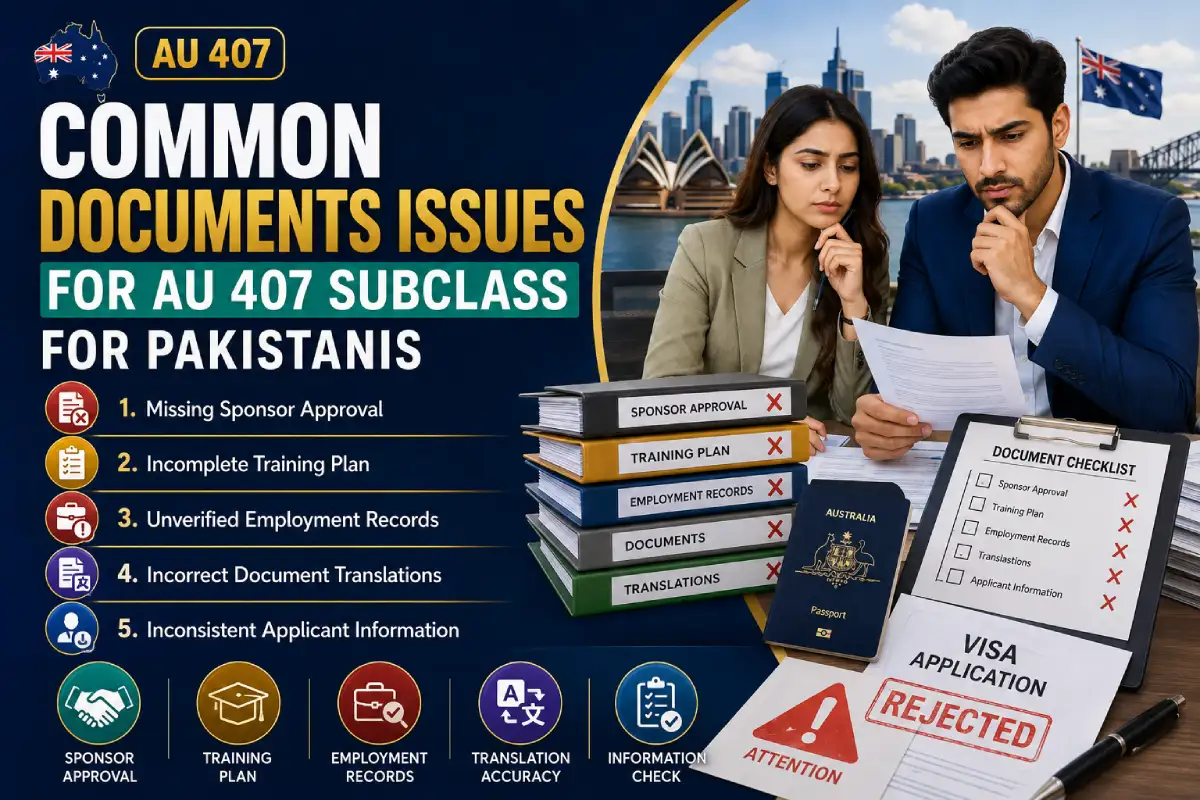
Common Document Issues for Pakistani Applicants
Pakistani applicants often hold documents from universities, employers, professional bodies and government authorities. Problems can arise when names, dates or job titles are recorded differently across these documents.
For example, an applicant’s passport may show a different name order from their university degree. An employment certificate may use initials, while the CNIC and passport display the full name. Experience letters may list a broad title without explaining the applicant’s actual duties.
These inconsistencies do not necessarily make a person ineligible, but they should be explained rather than ignored.
Applicants should check that:
- names match the passport or are supported by an explanation;
- employment dates are consistent across letters, contracts and salary records;
- experience letters describe duties, hours and reporting arrangements;
- qualification documents include transcripts where available;
- unexplained career gaps are addressed; and
- claims in the training plan match the applicant’s documented history.
Documents written wholly or partly in Urdu or another language must be translated into English. Applicants outside Australia should include the translator’s full name, contact details and relevant language qualifications, while providing both the original document and its translation.
Should the Program Be Workplace-Based or Classroom-Based?
The Training visa is mainly intended for occupational development, so the program should ordinarily involve meaningful workplace-based learning. It should not be presented as a substitute for an Australian university, college or general English-language course.
Classroom sessions can still form part of a legitimate plan. Technical workshops, safety briefings, software instruction, professional case studies and compliance training may support practical workplace activities. The correct balance depends on the training type.
A Pakistani hospitality supervisor might complete theoretical sessions on Australian food-safety standards before applying them during supervised hotel operations. An IT applicant might attend structured instruction on a specialised system and then complete practical implementation tasks under a senior engineer.
What matters is the connection between the classroom activity and the occupational outcome. The program should also identify how many hours will be spent on each activity, who will deliver it and how the trainee’s progress will be reviewed. A schedule containing only routine shifts and normal productive duties is unlikely to look like a genuine training program.
Sponsor Obligations During the Training
The sponsor’s responsibility does not end when the nomination and visa are approved. It must deliver the program described in the application and continue meeting its sponsorship obligations.
The sponsor should maintain evidence of:
- trainee attendance;
- completed training modules;
- supervisor meetings;
- progress assessments;
- practical competencies;
- changes to the training schedule; and
- any issues affecting the nominee’s participation.
Temporary Activities Sponsors must ensure that Subclass 407 visa holders undertake the program or activity described in their application. Sponsors can also face sanctions if they fail to meet their obligations.
Pakistani applicants should keep their own copies of training records, written feedback and communication with the sponsor. They should not agree to work in an unrelated role simply because an employer says it is “temporary.” Australian workplace protections generally apply to workers regardless of citizenship or visa status.
Avoiding Sponsorship Scams in Pakistan
Visa and sponsorship scams deserve special attention because a fraudulent arrangement can cost far more than money. False documents, invented employment histories or fake training plans can lead to refusal and create problems in future visa applications.
An applicant should treat the following claims as warning signs:
- “Guaranteed 407 visa without experience”
- “Buy an Australian sponsor”
- “No interview or documents required”
- “Pay now and receive the nomination letter”
- “We will create your experience documents”
- “You can work anywhere after arrival”
- “Do not contact the employer directly”
It is illegal for a person to pay an employer in exchange for visa sponsorship. This also includes salary deductions or providing another financial benefit to the employer for sponsorship.
Applicants using paid Australian immigration assistance should verify that the adviser is a registered migration agent or an Australian legal practitioner. Home Affairs warns that scam agents may take money without lodging an application, provide false documents or withhold visa decisions from applicants.
The Australian High Commission in Pakistan also advises applicants to research visa costs and requirements independently and warns that false or misleading information can result in refusal.
Practical Steps Before Accepting Sponsorship
Before accepting a training opportunity, a Pakistani applicant should request enough information to independently assess whether the arrangement is genuine.
Ask the sponsor for:
- its registered business name and Australian Business Number;
- confirmation of Temporary Activities Sponsorship approval;
- the proposed occupation and training type;
- the workplace location;
- the supervisor’s name and qualifications;
- a draft of the personalised training plan;
- details of remuneration or unpaid-training arrangements;
- expected weekly training hours;
- accommodation or travel responsibilities, if relevant; and
- a clear explanation of all costs.
Applicants should also speak directly with the Australian business rather than communicating only through a third-party agent.
After a visa application is lodged, Pakistani applicants may be asked to provide biometrics. In Pakistan, an appointment is currently not required for biometrics collection, but the applicant should bring their passport, photographic identification and the biometrics request letter issued by Home Affairs. No flights, resignation or major financial commitment should be based solely on an agent’s verbal promise.
Conclusion
Obtaining Subclass 407 visa sponsorship from Pakistan is possible when the arrangement is based on genuine professional development. The Australian organisation must hold the correct sponsorship approval, secure an eligible nomination and provide a structured training plan that matches the applicant’s existing background.
For Pakistani applicants, the strongest cases usually demonstrate three things clearly: credible qualifications and employment history, a specific skills gap, and a logical reason why the Australian organisation is suitable to provide the required training.
The process should never begin with the question, “How much does sponsorship cost?” It should begin with a more useful question: “What occupational training does this applicant genuinely need, and can this organisation properly deliver it?”
Applicants should verify the employer, avoid sponsorship sellers, review every document submitted in their name and confirm current requirements through Home Affairs or a properly registered migration professional.
Frequently Asked Questions
Can a Pakistani citizen apply for a Subclass 407 visa?
Yes. Pakistani citizens can apply if they satisfy the visa requirements and have an approved Australian sponsor, an eligible nomination and a genuine occupational-training program.
How can someone find a 407 sponsor from Pakistan?
Applicants can approach Australian employers, multinational companies, industry associations, professional contacts and organisations offering genuine workplace training. The approach should focus on the applicant’s skills gap and training objectives rather than simply requesting a visa sponsor.
Can an applicant pay an Australian employer for sponsorship?
No. Paying an employer, allowing sponsorship money to be deducted from salary or providing another benefit in exchange for sponsorship is illegal.
Can Urdu documents be used in the application?
Yes, but documents not in English must be accompanied by English translations. Applicants should submit both the original and translated versions, together with the required details of the translator.
Can a small Australian company sponsor a Pakistani trainee?
Potentially, yes. The business must be lawfully operating, receive the required sponsorship approval and demonstrate that it has the facilities, supervisors and resources needed to deliver the nominated training program.